Showing posts with label Ambassador Gordon Sondland. Show all posts

Friday, April 29, 2022

October 18, 2019: Mick Mulvaney Holds Up Three Fingers - Claims He Held Up Two


That would be two fingers, according to Mick Mulvaney.


10/18/19: George Kent, a career diplomat, appeared next to be grilled by the House panel investigating Trump’s July 25 call. He told lawmakers that as early as 2015, he had concerns about the work Hunter Biden was doing in Ukraine. According to CNN, Kent warned that “it could undercut American efforts to convey to Ukraine the importance of avoiding conflicts of interest.” 

Point for Team Trump!!!


____________________ 

The “drug deal” cooked up by Rudy and Mick.

____________________ 


Republicans had little chance to celebrate that news. Kent went on to say that Trump & Co. had made baseless claims against Ambassador Yovanovitch, the woman Giuliani and his now-arrested pals so desperately wanted removed. Even worse, Kent was said to have testified that Acting White House Chief of Staff Mick Mulvaney oversaw a meeting in which regular State Department personnel were sidelined. In their stead, political appointees, Rick Perry, now-resigned, Sondland and Volker would run the show. 

“The Three Amigos,” Kent said they dubbed themselves. 

(Volker, at least, seems to have had the best interests of Ukraine at heart. Sondland is more problematic.) 

Perry? Hard to tell. But money does talk. 

And Naftogaz was BIG MONEY. (See: 10/16/19.) 

$$$$$$$$$$$


* 

A counterintelligence risk to the United States. 

KENT WASN’T the only career diplomat to point a finger at Mulvaney. Dr. Fiona Hill – a member of Trump’s National Security Council – testified that her boss, National Security Advisor John Bolton, was so alarmed by the president’s efforts to get Ukrainian officials to investigate Joe and Hunter Biden, that he told her to lodge protest with John Eisenberg, the top lawyer for the NSC. 

According to Dr. Hill, who testified next, Bolton referred to Rudy as “a hand grenade” that was going to blow everyone to bits. Bolton wanted no part of the “drug deal,” as he likened it, cooked up by Rudy and Mick, to hold up military aid.  

Hill is also reported to have told lawmakers that she considered what was going on to be a counterintelligence risk to the United States. 

If the White House hoped for relief, it would have to come when Ambassador Sondland, a longtime, bigtime GOP donor, testified behind closed doors. Most of what he related is still unknown. Rep. Jackie Speier of California, a Democrat, told reporters that Sondland’s remarks were “a lot of C.Y.A.” Even worse – or better, depending on where you stand on the political spectrum – his testimony may have cracked the foundations of the president’s defense. Yovanovitch, for instance, Sondland called “an excellent diplomat.” Her departure, he “regretted.”  

As for Giuliani’s role in Ukraine, Sondland was mystified as to why he was there. According to his opening statement, as The New York Times explains, 

Mr. Sondland said Mr. Trump refused the counsel of his top diplomats, who recommended that he meet with the new Ukrainian president, Volodymyr Zelensky, without any preconditions [emphasis added, unless otherwise noted]. The president said the diplomats needed to satisfy concerns that both he and Mr. Giuliani had related to corruption in Ukraine, Mr. Sondland asserted.


“We were also disappointed by the president’s direction that we involve Mr. Giuliani,” Mr. Sondland said. “Our view was that the men and women of the State Department, not the president’s personal lawyer, should take responsibility for all aspects of U.S. foreign policy toward Ukraine.”


“Please know that I would not have recommended that Mr. Giuliani or any private citizen be involved in these foreign policy matters,” Sondland said in his statement to lawmakers. “However, given the president’s explicit direction, as well as the importance we attached to arranging a White House meeting between Presidents Trump and Zelensky, we agreed to do as President Trump directed.” 

“I did not understand, until much later,” Sondland added, “that Mr. Giuliani’s agenda might have also included an effort to prompt the Ukrainians to investigate Vice President Biden or his son or to involve Ukrainians, directly or indirectly, in the president’s 2020 re-election campaign.” 

Sondland was clearly indicating that the main charge that could lead to impeachment was true.


* 

“No question…That’s why we held up the money.” 

BY SOME COSMIC MISCHANCE, Mick Mulvaney appeared before reporters around the same time Sondland was testifying. The only way to explain Mulvaney’s performance is to assume that he knew, via leaks from GOP lawmakers, that what Sondland was saying was undermining the president’s defense. 

That meant Mulvaney had to no choice but to go out and defend the indefensible – to admit that part of the damning story was true – but not the most damning part. 

Mulvaney admitted that military aid to the Ukraine was held up because the White House wanted cooperation in what he insisted was a legitimate investigation by the Department of Justice. It was, he added, the president’s prerogative to conduct diplomacy in any fashion he pleased. 

(In short order, the DOJ went out of its way to rebut Mulvaney’s claim. “If the White House was withholding aid from Ukraine with regard to any investigation by the Justice Department, that’s news to us,” a DOJ spokesperson said.) 

It didn’t matter, Mulvaney argued, if Team Trump was pushing the Ukrainians to investigate matters related to the 2016 campaign. See! The president wasn’t soliciting information to help him in 2020! 

Trump only wanted to clean up corruption. He only wanted to know what had happened three years ago, even if investigating the Biden family would help next year. “I have news for everybody,” Mulvaney told the gathered reporters, thumping his lectern, “Get over it. There’s going to be political influence in foreign policy.” To sum up, he added, “Elections have consequences. This happens all the time.” 

What about the holdup of U.S. military assistance? Mulvaney was clear. There were “three issues,” involved. He held up three fingers, while cameras rolled, and ticked them off. First, there was the fear of ongoing corruption in the Ukraine. Second, there was frustration because other European governments weren’t helping Ukraine more. Third, was the president’s demand that the Ukrainians investigate the issue, from 2016, of the Democratic National Committee server.


“Did he also mention to me in passing the corruption related to the D.N.C. server?” Mulvaney said, referring to the president. “Absolutely. No question about that. That’s why we held up the money.” 

So, there it was. 

Trump held up military aid to force Ukraine to investigate some nutty right-wing conspiracy theory. Essentially, that would be the theory that Ukraine, not Russia, was involved in the 2016 theft of emails from the Democratic National Committee and the Democratic Congressional Campaign Committee. Therefore, proving that Trump never had Russian help in his election. 

Mulvaney wasn’t done. Asked if what George Kent said was true (that Mulvaney set up a meeting to put three political appointees in charge of diplomacy), Mulvaney played dumb. World-class dumb. He said he had no idea who Kent was. Didn’t think he’d ever talked to the man. Several times, when reporters pressed, Mick couldn’t recall who U.S. diplomats were. 

The casual observer had to wonder if he’d been ingesting illegal drugs for breakfast. 

What about all the testimony from diplomats that seemed to confirm everything the whistleblower had said? 

How did Mulvaney explain that? 

“What you’re seeing now I believe,” he grumbled, “is a group of mostly career bureaucrats who are saying, ‘You know what, I don’t like President Trump’s politics, so I’m going to participate in this witch hunt that they are undertaking on the Hill.’” 

Besides, who were you going to believe? A bunch of “career bureaucrats?” 

Or career politicians, like Mulvaney? 

And Rudy, whose four pals were under arrest? 

And Trump! Did reporters – and through them, the American people – really believe Donald J. Trump would lie about all of this – just because he had lied about everything else since taking office?


If Mulvaney’s performance was jaw-droppingly awful, it wasn’t long before he tried a do-over. A few hours later he issued a statement, “clarifying” what he had said. 

Once again, the media has decided to misconstrue my comments to advance a biased and political witch hunt against President Trump. Let me be clear, there was absolutely no quid pro quo between Ukrainian military aid and any investigation into the 2016 election. The president never told me to withhold any money until the Ukrainians did anything related to the server.


Only Mulvaney did say what he said. He absolutely said the Ukrainians had to investigate, or Trump would freeze aid. 

Get over it. 

Mulvaney later appeared on Fox News; but his host was Chris Wallace, not some stooge. That meant he ran into a buzz saw of questions. Mulvaney tried to claim he never listed three reasons Trump held up the military aid. There were only two, and he ticked them off for Wallace again – leaving out any mention of an investigation of the Biden family or any other issue from 2016. 

Wallace said he was wrong and absolutely had said that there were three.


* 

Ukraine “lives in the shadow of Russia.” 

SO, WAS THERE a quid pro quo or wasn’t there? Some days back, Sen. Ron Johnson told the Wall Street Journal that he had been told of a possible quid pro quo by Ambassador Sondland. Johnson said he pressed Trump about the matter in a phone call. “He said...‘No way. I would never do that. Who told you that?’” 

Sen. Johnson told everyone he believed Trump; but up on Capitol Hill, Sondland was testifying that he had suspected there was a quid pro quo, just as he warned the senator before. Johnson appeared on Chuck Todd’s Sunday morning show and insisted that he had been mixed up when he talked to the Wall Street Journal. Now he believed Trump, and insisted that the president had “vehemently,” “adamantly” denied any quid pro quo. And, yes, the free press was mean and biased, and he, a two-bit politician, and the president, a liar at retail, would never have biases of their own. 

Like a chain-reaction wreck on a fog-enshrouded interstate, the president’s problems continued to pile up like smashed cars and trucks. A Fox News poll indicated that 51 percent of Americans supported impeachment and removal of the president. Newsweek reported that 58 percent in another poll agreed with the statement that Trump had definitely or probably done things that were “grounds for impeachment.” Former Gov. John Kasich of Ohio, a Republican, agreed. It was Mulvaney’s admission that military aid had been withheld, he explained, that tipped him to that conclusion. 

There was no excuse, Kasich said, not when Ukraine “lives in the shadow of Russia, that’s got troops on their land.”


Kasich was not the only Republican willing to express public concern. There were reports that many were privately appalled. Maryland Governor Larry Hogan joined in support of the inquiry. “I don’t see any other way to get the facts,” he said. 

Having listened to Mulvaney, Sen. Lisa Murkowski made her disgust clear. “You don’t hold up foreign aid that we [Congress] had previously appropriated for a political initiative. Period.”  

Maine Republican, Bill Cohen, one of seven on the House Judiciary Committee to vote for the impeachment of President Nixon in 1974, went a step further. “I believe the effort to obtain damaging information from a foreign government on a potential presidential candidate, and contemporaneously withholding needed military equipment would constitute an impeachable offense,” he told the Bangor Daily News. 

Rep. Francis Rooney was the next GOP member in Congress to say he supported an impeachment inquiry. Rep. Adam Kinzinger, of Illinois, joined him. Neither said they had their minds made. Both believed an investigation was warranted. “I’ve been real mindful of the fact that during Watergate, all the people I knew said, ‘Oh, they’re just abusing Nixon, and it’s a witch hunt,’” Rooney explained. “Turns out it wasn’t a witch hunt. It was absolutely correct. I’m definitely at variance with some of the people in [my] district who would probably follow Donald Trump off the Grand Canyon rim.” 

For his part, he said, he had sworn to uphold the U.S. Constitution. His loyalty was not to one man. 

The next day, Rooney announced that after two terms in the House, he would not run for reelection. 

Still, we’ve always got Rep. Duncan Hunter of California – at least until his trial. And, hey, Jim Jordan!


Ready to jump for Trump.


BLOGGER’S NOTE (4/28/22): In the process of editing my blog, I should note here: Hunter Biden had no business serving on the board of a Ukrainian company, and being paid, basically, for his family name. 

That doesn’t mean Rick Perry, Rudy Giuliani, Lev Parnas, Igor Fruman, and a host of other Trump-affiliated galoots weren’t trying to cash in on the exact kind of connections.

October 22, 2019: A Parade of Witnesses Has Implicated President Trump - Trump Fans Won't Care


10/22/19: If Trump was already having a bad month, Tuesday was his worst day yet. (Or, the best day for this country in almost three years.) 

On Tuesday, another U.S. diplomat marched up to Capitol Hill to testify behind closed doors. What leaked, and what he said in his 15-page opening statement, which was available to the press, must have made the president poop his pajamas. That veteran diplomat, Bill Taylor, was chosen by Mike Pompeo to replace the previous U.S. Ambassador to Ukraine, Marie Yovanovitch, who Trump went out of his way to dump. 

Call it karma.


If you heard the witnesses this week, you would BE concerned.


____________________ 

“If Bill Taylor says it happened, it happened.” 

Steven Pifer

____________________


If you aren’t following testimony in the impeachment inquiry, let’s just say that what’s leaking isn’t making Trump sound like a saint. The president’s staunchest defenders are outraged. Why are witnesses testifying behind closed doors! How dare Democrats leak damaging details! Why hasn’t Speaker Pelosi called for an official impeachment vote! Trump himself has called the inquiry a “kangaroo court.” He’s not going to cooperate. Lawmakers can’t make him. 


This created a national security threat. 

Still, the witnesses keep parading before Congress, and not one has defended the president so far. 

Here’s the capsule version. Yovanovitch indicated that she ran afoul of Rudy Giuliani, who wanted her canned. Rudy wanted her booted, she says, because she opposed his efforts to get the Ukrainians to investigate the Bidens. She also warned Rudy that the guys he was working with in Ukraine might be crooks. 

George Kent testified that he had concerns about what Hunter Biden was doing in Ukraine. But he was more concerned by what he saw as a White House effort to sideline regular diplomats and create an alternative channel of communication to Ukrainian leaders. And he couldn’t figure out what Rudy was up to – or why the Trump administration was delaying military aid. 


Kurt Volker resigned as soon as his name turned up in the first whistleblower’s complaint. The whistleblower reported that Volker and Ambassador to the European Union Gordon Sondland spoke with Giuliani “in an attempt to ‘contain the damage’” he was doing to U.S. national security. 

Volker, whose motives seem legit, told lawmakers that Giuliani and his pals were running a “shadow shakedown” in the Ukraine. 

Dr. Fiona Hill testified that her boss, John Bolton, referred to Rudy as “a hand grenade” who was going to blow everyone to bits. She considered what was going on, the interference with military aid, and the demand for Ukraine to investigate the Bidens, to represent a counterintelligence risk to the United States.


Ambassador Sondland seemed to tap dance around responsibility for any of the mess. He did defend Yovanovitch. He said that he and Volker agreed that President Trump should take a meeting with the President of Ukraine without precondition. Only later did he realize that Rudy Giuliani’s “agenda might have also included an effort to prompt the Ukrainians to investigate Vice President Biden or his son or to involve Ukrainians, directly or indirectly, in the president’s 2020 re-election campaign [emphasis added].” 

Trump took another right hook to the jaw when Michael McKinney, a top adviser to Secretary of State Pompeo, resigned and appeared voluntarily before the House Intelligence Committee. His opening statement makes his position clear: 

The timing of my resignation was the result of two overriding concerns: the failure, in my view, of the State Department to offer support to Foreign Service employees caught up in the Impeachment Inquiry on Ukraine; and, second, by what appears to be the utilization of our ambassadors overseas to advance domestic political objectives [emphasis added].


I was disturbed by the implication that foreign governments were being approached to procure negative information on [the president’s] political opponents. I was convinced that this would also have a serious impact on foreign service morale and the integrity of our work overseas.


In other words, Sondland and McKinney thought there was a quid pro quo. Dr. Hill thought so, too. This created a national security threat. Kurt Volker thought Rudy’s efforts, and the hold put on military aid, were a security threat. George Kent worried about Hunter Biden’s work but wanted to make it clear he thought it was fishy that regular diplomats were being pushed aside. Ms. Yovanovitch wasn’t sure what had happened to her, or why, and left Ukraine before the diplomatic doo hit the fan. She believed the people Giuliani was working with were kind of sleazy.


* 

BY THE TIME Ambassador Bill Taylor arrived to testify, Team Trump appeared to be on the ropes. 

From what we know – and Republicans remain outraged because witnesses are appearing behind closed doors – and maybe not so much because of what they are saying while they’re there – Taylor may have knocked the president down for a nine-count. In fact, there would seem to be an excellent chance, that when Chairman Schiff finally decides he has enough evidence to open hearings to the public, the friends of President Trump will be sorry they asked. 

We know Taylor had a distinguished career as diplomat. He left public service some years back. Secretary of State Mike Pompeo convinced him to return last spring and take the job as charge d’affaires to Ukraine. Taylor is a West Point graduate and served during the Vietnam War. 

He was a company commander in the 101st Airborne Division and was awarded a Bronze Star. 

In 2006, President George W. Bush chose him to be Ambassador to Ukraine, and he served for three years, until President Obama replaced him with an ambassador of his own. At age 72, when Pompeo asked, Taylor was reluctant to return. A Republican mentor helped change his mind. 

“If your country asks you to do something, you do it—if you can be effective,” Taylor testified his mentor said.


As for character, Taylor would be a hard man for Trump fans to attack. (But, as we shall see, they do.) A veteran diplomat from the Bush administration described him as “a person of integrity with a strong, ethical base.” A former ambassador to the Soviet Union agreed. “You couldn’t ask for a more credible, universally respected, upright public servant to testify on the facts of this case.” Steven Pifer, former U.S. ambassador to Ukraine, was even more confidant in what Taylor might say. “If Bill Taylor says it happened, it happened,” he told reporters. 

So, what did Taylor tell lawmakers on Wednesday? First, we learn that he’s a meticulous notetaker. He said he shared his notes with the State Department, which refused to turn them over to congressional panels involved in the inquiry. Taylor kept a copy for himself. 

It didn’t take long for Ambassador Taylor to start ringing alarm bells. In the first three paragraphs of his opening statement he explained who he was. He was a Vietnam veteran, a career diplomat with fifty years of experience, a man who had served every U.S. president since 1985.


In his fourth paragraph he rang the first bell. 

While I have served in many places and in different capacities, I have a particular interest in and respect for the importance of our country’s relationship with Ukraine. Our national security demands that this relationship remain strong, However, in August and September of this year, I became increasingly concerned that our relationship with Ukraine was being fundamentally undermined by an irregular, informal channel of U.S. policy-making and by the withholding of vital security assistance for domestic political reasons [emphasis added].


That would be another vote for: “Yes, there was a quid pro quo.” 


“Whole, free, democratic, and at peace.” 

Nor did Taylor feel that the U.S. could afford to ruin its relationship with Ukraine. In his fifth paragraph, he explained: 

First, Ukraine is a strategic partner of the United States, important for the security of our country as well as Europe. Second, Ukraine is, right at this moment – while we sit in this room – and for the last five years, under armed attack from Russia. Third, the security assistance we provide is crucial to Ukraine’s defense against Russian aggression, and, more importantly, sends a signal to Ukrainians – and Russians – that we are Ukraine’s reliable strategic partner. And finally, as the Committees are now aware, I said on September 9 in a message to Ambassador Gordon Sondland that withholding security assistance in exchange for help with a domestic political campaign in the United States would be “crazy.”


If Ukraine could break free of Russian influence, he continued, it would be “possible for Europe to be whole, free, democratic, and at peace.” An American president could stand by Ukraine and shape a better world. 

Taylor arrived in Kyiv, the capital of Ukraine, on June 17, 2019. He was carrying a letter from Mr. Trump, inviting Mr. Zelensky to meet in the White House. What Taylor discovered on arrival was “a weird combination of encouraging, confusing, and ultimately alarming circumstances.” He was encouraged by Zelensky’s desire to root out corruption. He was confused to find there were two diplomatic tracks at work, one “highly irregular,” on which Rudy Giuliani ran the train. 

At first, Taylor said, all the American principals agreed a meeting between Trump and Zelensky would benefit both nations. As other witnesses had made clear, he too said he soon realized Rudy was tearing up the regular diplomatic rails. If Zelensky hoped to meet with Trump, he was going to have to push “the investigation of Burisma and alleged Ukrainian interference in the 2016 U.S. election.” By July 10, Taylor was hearing from top Ukrainian officials who said Giuliani had told them a phone call between the two leaders was not going to happen. 

Unless.


They told Taylor they were “disappointed and alarmed.” Eight days later, he heard another U.S. official say that “there was a hold on security assistance to Ukraine but could not say why.” 

The picture emerging was damning to President Trump and Lawyer Rudy, in the extreme. So, Republicans fell back on arguing that what Taylor was saying was “thirdhand hearsay.” 

And some of it was. 

And most of it wasn’t. 


“Contrary to the goals of longstanding U.S. policy.” 

Taylor’s opening statement continued. During one “otherwise normal meeting,” he and other diplomats listened to a “voice” on a conference call. Who was speaking, he did not know: 

…the person was off-screen – said that she was from OMB [Office of Management and Budget] and that her boss had instructed her not to approve any additional spending of security assistance for Ukraine until further notice. I and others sat in astonishment – the Ukrainians were fighting the Russians and counted on not only the training and weapons, but also the assurance of U.S. support. All that the OMB staff person said was that the directive had come from the President to the Chief of Staff [Mick Mulvaney] to OMB. In an instant, I realized that one of the key pillars of our strong support for Ukraine was threatened. The irregular policy channel was running contrary to the goals of longstanding U.S. policy.


A series of high-level discussions followed. According to Taylor, “the unanimous conclusion” was that military aid should be resumed. There should be no conditions attached. The Department of Defense was in favor. 

(Taylor had been keeping painstaking notes.)


Subsequently, other U.S. diplomats and government officials told Taylor that the hold on military aid and the hold on any meeting between the two presidents had to do with White House insistence on certain “investigations.” In one meeting, Taylor was told, National Security Advisor Bolton (Taylor mistakenly called him “Ambassador Bolton” in his opening remarks), became so upset over the hold, that he terminated discussion. Bolton told Hill, who told Taylor, that he wanted no part of the “drug deal” White House Chief of Staff Mick Mulvaney and Giuliani were cooking up. “Bolton” now opposed a call between the two leaders “out of concern that it ‘would be a disaster.’”


In a conversation with Mr. Sondland on July 20, Sondland told Taylor he had recommended a phrase for Zelensky to use if he did talk to Trump. “I will leave no stone unturned,” he was to say, in pursuing the investigations Trump so much wanted. 

It was all about Biden, father, and son. 

Taylor was not in on the critical call between the presidents on July 25. Everything he says he had heard previous witnesses had verified. 

Shortly thereafter, Volker and Taylor traveled to the front lines, where sporadic fighting still flares almost every day. Looking across a damaged bridge, where a river separated the two sides, Taylor could see heavily-armed Russian forces. He thought of the 13,000 Ukrainian dead. “More Ukrainians would undoubtedly die without the U.S. assistance,” he realized at that moment. 

That was how he explained it to lawmakers.


By late August, his concern had intensified. Military assistance had been on hold for weeks. On August 27, Bolton flew to Kyiv to talk to Zelensky. Taylor spoke to Bolton about his worries. Bolton recommended sending a first-person cable to Secretary of State Pompeo. Taylor did. 

A top Ukrainian official asked him about the aid delay on August 29. 

“At that point,” Taylor testified, “I was embarrassed that I could give him no explanation for why it was withheld.” 

“It had still not occurred to me that the hold on security assistance could be related to the ‘investigations.’ That, however, would soon change,” he told the House Intelligence Committee. On September 1, he was told that Sondland had warned the Ukrainians that “the security assistance money would not come until President Zelenskyy committed to pursue the Burisma investigation.”  

So, was there a quid pro quo? 


Everything, including security assistance, was dependent. 

We knew from earlier testimony, that Sondland had assured Taylor in an email that Trump said there were no quid pro quos. But Taylor told lawmakers, Sondland went on to admit that there were. President Zelensky would have to announce he was investigating Joe Biden and his son or forget any military assistance. “Ambassador Sondland said that ‘everything’ was dependent on such an announcement, including security assistance,” Taylor explained. 

“He said that President Trump wanted President Zelensky ‘in a public box’ by making a public statement about ordering such investigations.” Other diplomats made it clear that Trump was adamant. The president claimed he wasn’t asking for a quid pro quo. But, as Taylor described it, he was insisting “that President Zelenskyy go to a microphone and say he is opening investigations of Biden and 2016 election interference.” On September 8  Sondland told Taylor,  that the U.S. and Ukraine were in a “stalemate.” Zelensky would have to “clear things up” in public. 

“I understood a ‘stalemate’ to mean that Ukraine would not receive the much-needed military assistance,” Taylor told the committee, until the Ukrainians committed to what amounted to interference in the next U.S. election. 

And that’s all we knew, by Tuesday afternoon.


* 

TAYLOR MIGHT BE a decorated war hero and a man of unflinching integrity and courage, according to peers. Yet, by Tuesday evening, White House Press Lacky Stephanie Grisham, was out with a statement. In it, she bashed Taylor and the other witnesses, including those who Trump had chosen to fill their posts. Grisham insisted that the president had “done nothing wrong.” 

The witnesses were part of “a coordinated smear campaign from far-left lawmakers and radical unelected bureaucrats waging war on the Constitution.”

Wednesday, April 27, 2022

November 6, 2019: Sondland Says Security Aid to Ukraine Was in Our Vital National Interest


11/6/19: At a rally in Kentucky, standing beside “Fat Nixon,” Sen. Rand Paul shouts that it’s time for the free press to “do your job.” 

Yes, Sen. Paul wants the free press to………expose the whistleblower! 

Name him (or her), he shouts.


____________________ 

“Have you no sense of decency? At long last, have you no sense of decency?” 

Joseph Welch, replying to Sen. Joseph McCarthy

____________________


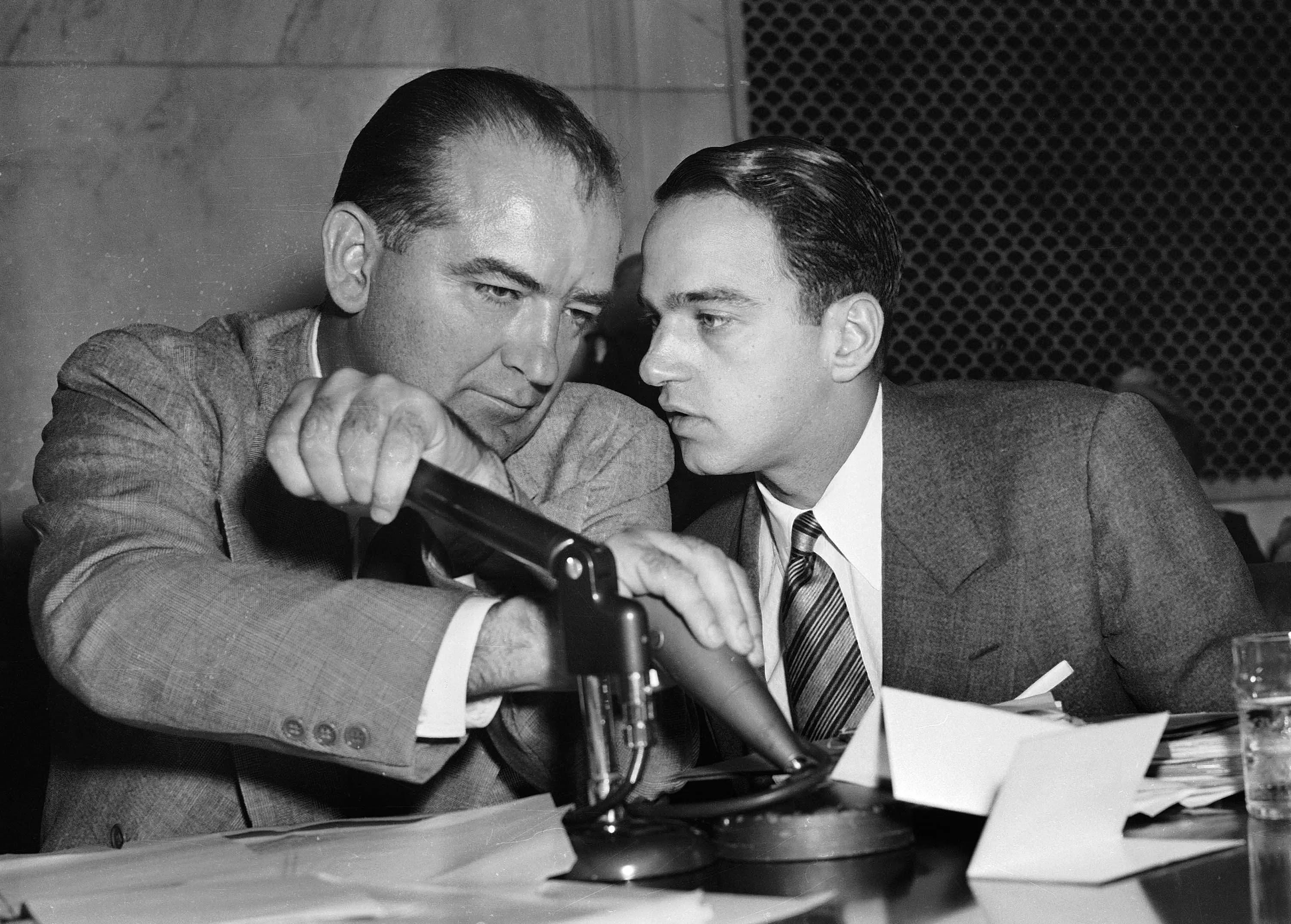
For once, this threat proves too much even for some of Sen. Paul’s GOP colleagues. A lawless president has trampled a supine Republican Party for years. Perhaps we are approaching our “Joseph Welch” moment. 

This was the televised instant in 1954, when Welch, representing the U.S. Army during congressional hearings, reached a point where he had had all he could stand. Sen. Joe McCarthy was attacking the reputation of a young lawyer on Welch’s staff, without producing any evidence. 

“Until this moment, Senator,” Welch said with icy calm, “I think I never really gauged your cruelty or your recklessness.” When McCarthy dared continue, Welch interrupted angrily. “Let us not assassinate this lad further, senator. You have done enough. Have you no sense of decency? At long last, have you no sense of decency?” 

In fact, like President Trump, McCarthy did not. From that moment forward, McCarthy went into decline.


Sen. Joseph McCarthy, left, with aid Roy Cohn.

(Ironically, Cohn would later be a confidante of Donald J. Trump.)


Now a few Republicans dared, if not to stand tall, at least not to crawl and crouch. “We should follow the law,” Sen. Lamar Alexander said. “And I believe the law protects whistleblowers.” 

“The whistleblower statute is there for a reason,” Sen. John Thune agreed. “And I think we need to respect the law where whistleblowers are concerned. Eventually that person may decide to come forward voluntarily.” 

Sen. Chuck Grassley, who has worked for years to build up whistleblower protections, concurred. “All I can say is I expect whistleblowers to be protected according to what the law gives them,” Grassley explained.


But Sen. Rand Paul stood by his threat to name names; and Sen. Lindsey Graham backed his craven play. 

Cowardice runs thick in most Republican veins.


* 

SEN. JOHN CORNYN hits the nail square on the head. There’s not much reason to go hunting the whistleblower now. “It’s kind of a moot issue,” he says. “People can read the transcript themselves.” 

Yes, they can! People are free to read the original nine-page whistleblower complaint. It won’t even take long. 

Or they can dive into the transcripts documenting the testimony of career diplomats and military men, which are being released daily. Even a cursory reading shows that the whistleblower complaint has been validated on nearly every point. As Sen. Cornyn says, the whistleblower’s identity is “kind of a moot issue.” 


Rep. Jim Jordan cites two entire words from a transcript. 

You can take your pick of transcripts if you want to dig for truth. On Twitter, Rep. Jim Jordan does just that. He selects one transcript, and cites two entire words of testimony to prove that Donald J. Trump is the best man ever to plant a fat fanny in the Oval Office.


Interesting how Rep. Jordan wants to ignore hundreds of pages of transcripts,

save for two words: "no linkage."


Of course, if you really wanted to understand what was going on, you could dive deeper. You had, for example, the 156 pages of testimony from Michael McKinley – who, by the way, accused Secretary of State Mike Pompeo of lying. You could read Ambassador Marie Yovanovitch’s testimony, 317 pages in length. If you enjoyed that you could wade through 360 pages of testimony provided by Ambassador Volker, not simply pluck out two random words. 

Or you could delve into the 379 pages served up for lawmakers by Ambassador Gordon Sondland. That would include the four pages of amended testimony Sondland added after his memory was jogged by testimony from Ambassador Bill Taylor and National Security Council official Tim Morrison, and, perhaps, motivated by fear he might have perjured himself.


* 

BY THE WAY, Sen. Graham, who really wants good Americans to know the name of the whistleblower, has said that he’s not going to read any of this testimony, because, 

lalalalalalalalalalalalalalalalalalala… 

He doesn’t care what any of the witnesses have said. 

Let’s go the senator one better, and tax our brains and peruse just the last four pages of amended testimony from Ambassador Sondland. His original comments provided President Trump at least a fig leaf of cover. 

Now to remove that fig leaf and… 

Gag.


“Security aid to Ukraine was in our vital national interest.” 

As early as May 23, 2019, Sondland originally said, he understood that, 

a White House visit for President Zelensky was conditioned upon President Zelensky’s agreement to make a public anti-corruption statement. This condition had been communicated by Rudy Giuliani, with whom President Trump directed Ambassador Volker, [Energy] Secretary [Rick] Perry, and me…to discuss issues related to the President’s concerns about Ukraine.


Sondland added, “I understood that satisfying Mr. Giuliani was a condition for scheduling the White House visit, which we all strongly believed to be in the mutual interest of the United States and Ukraine.” 

So, last spring, there was already a quid and a quo, and Sondland knew it. Zelensky gets the meeting. Quid. 

Rudy and his boss get an anti-corruption statement that they hope will damage Joe Biden. 

Quo.


Now, in his amended testimony, Sondland has even more to say. This time he related a meeting in Warsaw, on September 1, involving Vice President Pence and Mr. Zelensky. Three days earlier, the suspension of U.S. military aid to Ukraine had been revealed by the free press. Now the suspension of aid was openly discussed. “I always believed that suspending aid to Ukraine was ill-advised,” Sondland made clear in his amended testimony, “although I did not know (and still do not know) when, why, or by whom the aid was suspended.” 

Is this, then, a second and more critical quid pro quo? Sondland explained, that in the absence “of any credible explanation for the suspension of aid, I presumed that the aid suspension had become linked to the proposed anti-corruption statement. As I said in my [original] prepared testimony, security aid to Ukraine was in our vital national interest and should not have been delayed for any reason.” 

Sondland’s amended testimony offers depth to our understanding of what was happening behind the scenes. At the conclusion of the meeting in Warsaw, he told lawmakers, “President Zelensky had raised the issue of suspension of U.S. aid to Ukraine directly with Vice President Pence.” In fact, it had been the first matter Zelensky brought up, to start the meeting. Afterwards, Sondland spoke briefly with Andrey Yermak, a top adviser to Zelensky. He told Yermak “that resumption of U.S. aid would likely not occur until Ukraine provided the public anti-corruption statement that we had been discussing for many weeks [emphasis added].”


Soon after, he learned that “the public statement would need to come directly from President Zelensky himself.” 

Military aid. Quid. 

Zelensky gives Trump a statement he badly wanted. 

Quo.


Sondland goes on to say he cannot recall whether he had “one or two phone calls with President Trump in the September 6-9 time frame.” He does know this. 

Despite repeated requests to the White House and the State Department, I have not been granted access to all of the phone records, and I would like to review those phone records, along with any notes and other documents that may exist, to determine if I can provide more complete testimony to assist Congress.


Or as Sen. Lindsey Graham might say, 

Lalalalalalalalalalalalalalalalalalalalalalaaaaaaaaaaaaaaaaaaaaaaaaaaaa. 


NOT-SO-FUN-FACT: Ambassador Sondland is the second person to testify, after Bill Taylor, that the Department of State has refused to let him review his own documents to prepare for testimony in front of Congress.